
How the elephant Rivaldo escaped
In 2022, Priya Davidar and I were witnesses to wildlife management at its worst and got quasi-forced to write a paper about it (Puyravaud and Davidar 2022). The issue was how an elephant called Rivaldo was handled. It was dark, absurd and tedious to narrate. It may even have been impossible to believe if had not been in the newspapers.
In his best-selling book “Parkinson’s Law or the Pursuit of Progress”, Northcote Parkinson jokes about how organizations become ineffective. The charm of the book resides in the fact that the comical stories turn out to be frighteningly accurate. Work, would posit Parkinson, expands so as to fill the time available for its completion. He also mocks how interviews are conducted in the Royal Navy and he proposes a new medical term “injelititis”: the disease which is manifested when a incompetent and jealous person comes to power.
The background of Parkinson’s stories is the slow erosion of values where the message takes over the product, the egos taint decisions and personal gains become the untold driving force for action. Diversion of activities runs under the cover of honesty and affects all sectors from the IT industry to NGOs to insurance companies to governments. To the innocent onlooker who is supposed to believe that the organization still works to achieve its objectives, it appears absurd. In reality, it is not absurd. It is like playing a game with rules that are changing without our knowledge. But thankfully, we laugh at absurdity. With absurdity, it becomes easier to pile a series of unfortunate events without losing the reader in long meanders of cause and effect. So let us come back to our unfortunate hero.
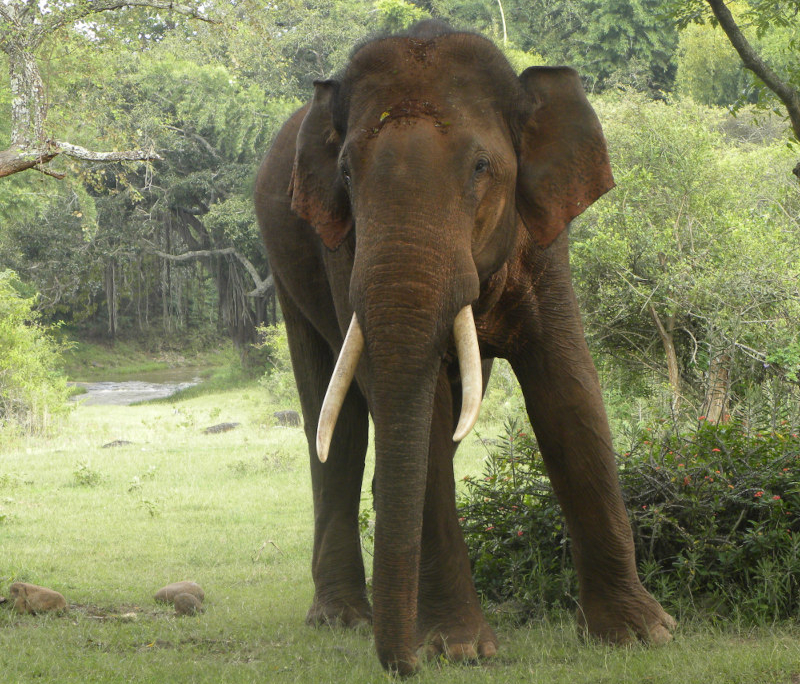
Rivaldo in November 2010.
Rivaldo was a gentle elephant that became habituated to human presence as he was fed. He had lost his fear of humans and would enter private properties. He was usually tolerated until a retired HR manager lady settled in the region and did not like his incursions. She introduced herself as the regional representative of the Society for the Prevention of Cruelty to Animals (SPCA). Rivaldo, entered her garden and broke some pots. She took it upon herself to remove the elephant from the wild. She suggested to the authorities that he should be captured and “rehabilitated” in an elephant camp. She claimed, without evidence that the elephant was blind, deaf, could not breathe, was frightened of other elephants and could not feed. All corners of illness had been covered. Some forest officials readily agreed to this diagnosis and had a kraal (cage) made of teak constructed to capture him. Large sums of the taxpayer money can be made available to implement unnecessary projects. The elephant was captured and the “rehabilitation” program followed. Breaking a wild elephant is a cruel process. The animal is left standing for weeks, starved and beaten into submission. The self-appointed SPCA regional representative had been made aware of the nature of the treatment but being a sensitive person, removed “cruelty” from her vocabulary for a while. The team promised everyone, including the Court, that this was the most humane course – even though veterinary doctors working under the same forest managers did not overtly support this operation.
As we used to see this elephant almost every day and even wrote a scientific paper about his behaviour (Puyravaud et al. 2016), we were especially not asked for our opinion. We demonstrated that Rivaldo was not blind (his right eye had been damaged by people, but he could see well from the left eye). We demonstrated that he could hear, he could breathe (he could drink water through his trunk, so air could easily enter his nose), and he could stand his ground against some tuskers, but would run from others, a fairly normal behaviour. We managed to send a video of Rivaldo feeding just before a meeting discussing his fate – without success. He got locked and his “rehabilitation” started. No one, including top conservationists could do anything to liberate the elephant.
Then, catastrophe. A new Chief Minister of Tamil Nadu was elected. A new set of top officials were posted including a new Chief Wildlife Warden. He became aware of the Rivaldo case, inspected the elephant and consulted veterinarians. Since there was no reason why the elephant should be sent to a camp, he signed a release order. In a few weeks, Rivaldo was back in the jungle.
Maybe Rivaldo was released because ultimately reason prevailed. A less optimistic interpretation consists in thinking that the change of government was a black swan, a totally unexpected event relative to the capture, that can dramatically change the outcome of predictions. In which case the black swan changed everything for Rivaldo and nothing for the system. Chose according to your preference.
Jean-Philippe Puyravaud, 10 September 2026.
References
Puyravaud, J.-P., & Davidar, P. (2022). Spatial justice for elephants: The case of the Nilgiri Biosphere Reserve (southern India). Justice Spatiale | Spatial Justice, 17. http://www.jssj.org
Puyravaud, J.-P., Puyravaud, S., & Davidar, P. (2016). Can a wild Asian elephant change its interaction patterns with humans? Gajah, 44, 30–32.
Acknowledgement
Priya Davidar reviewed this article.
About this post
This post was written without the use of AI.