How the elephant Rivaldo escaped


In 2022, Priya Davidar and I were witnesses to wildlife management at its worst and got quasi-forced to write a paper about it (Puyravaud and Davidar 2022). The issue was how an elephant called Rivaldo was handled. It was dark, absurd and tedious to narrate. It may even have been impossible to believe if had not been in the newspapers.

In his best-selling book “Parkinson’s Law or the Pursuit of Progress”, Northcote Parkinson jokes about how organizations become ineffective. The charm of the book resides in the fact that the comical stories turn out to be frighteningly accurate. Work, would posit Parkinson, expands so as to fill the time available for its completion. He also mocks how interviews are conducted in the Royal Navy and he proposes a new medical term “injelititis”: the disease which is manifested when a incompetent and jealous person comes to power.

The background of Parkinson’s stories is the slow erosion of values where the message takes over the product, the egos taint decisions and personal gains become the untold driving force for action. Diversion of activities runs under the cover of honesty and affects all sectors from the IT industry to NGOs to insurance companies to governments. To the innocent onlooker who is supposed to believe that the organization still works to achieve its objectives, it appears absurd. In reality, it is not absurd. It is like playing a game with rules that are changing without our knowledge. But thankfully, we laugh at absurdity. With absurdity, it becomes easier to pile a series of unfortunate events without losing the reader in long meanders of cause and effect. So let us come back to our unfortunate hero.
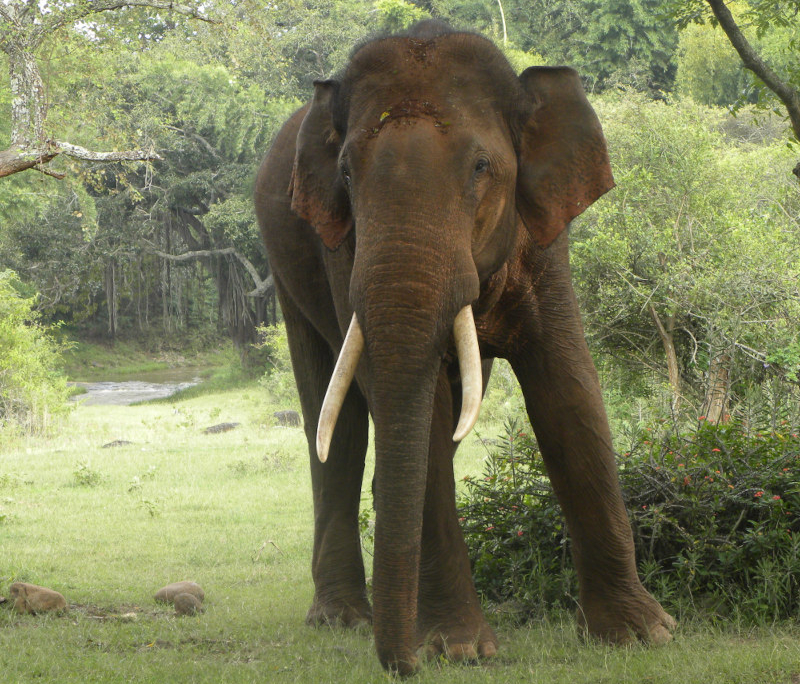
 

Rivaldo in November 2010.

Rivaldo was a gentle elephant that became habituated to human presence as he was fed. He had lost his fear of humans and would enter private properties. He was usually tolerated until a retired HR manager lady settled in the region and did not like his incursions. She introduced herself as the regional representative of the Society for the Prevention of Cruelty to Animals (SPCA). Rivaldo, entered her garden and broke some pots. She took it upon herself to remove the elephant from the wild. She suggested to the authorities that he should be captured and “rehabilitated” in an elephant camp. She claimed, without evidence that the elephant was blind, deaf, could not breathe, was frightened of other elephants and could not feed. All corners of illness had been covered. Some forest officials readily agreed to this diagnosis and had a kraal (cage) made of teak constructed to capture him. Large sums of the taxpayer money can be made available to implement unnecessary projects. The elephant was captured and the “rehabilitation” program followed. Breaking a wild elephant is a cruel process. The animal is left standing for weeks, starved and beaten into submission. The self-appointed SPCA regional representative had been made aware of the nature of the treatment but being a sensitive person, removed “cruelty” from her vocabulary for a while. The team promised everyone, including the Court, that this was the most humane course – even though veterinary doctors working under the same forest managers did not overtly support this operation.

As we used to see this elephant almost every day and even wrote a scientific paper about his behaviour (Puyravaud et al. 2016), we were especially not asked for our opinion. We demonstrated that Rivaldo was not blind (his right eye had been damaged by people, but he could see well from the left eye). We demonstrated that he could hear, he could breathe (he could drink water through his trunk, so air could easily enter his nose), and he could stand his ground against some tuskers, but would run from others, a fairly normal behaviour. We managed to send a video of Rivaldo feeding just before a meeting discussing his fate – without success. He got locked and his “rehabilitation” started. No one, including top conservationists could do anything to liberate the elephant.

Then, catastrophe. A new Chief Minister of Tamil Nadu was elected. A new set of top officials were posted including a new Chief Wildlife Warden. He became aware of the Rivaldo case, inspected the elephant and consulted veterinarians. Since there was no reason why the elephant should be sent to a camp, he signed a release order. In a few weeks, Rivaldo was back in the jungle.

Maybe Rivaldo was released because ultimately reason prevailed. A less optimistic interpretation consists in thinking that the change of government was a black swan, a totally unexpected event relative to the capture, that can dramatically change the outcome of predictions. In which case the black swan changed everything for Rivaldo and nothing for the system. Chose according to your preference.

Jean-Philippe Puyravaud, 10 September 2026.

References

Puyravaud, J.-P., & Davidar, P. (2022). Spatial justice for elephants: The case of the Nilgiri Biosphere Reserve (southern India). Justice Spatiale | Spatial Justice, 17. http://www.jssj.org

Puyravaud, J.-P., Puyravaud, S., & Davidar, P. (2016). Can a wild Asian elephant change its interaction patterns with humans? Gajah, 44, 30–32.

Acknowledgement

Priya Davidar reviewed this article.

About this post

This post was written without the use of AI.
How the Todas’ sacred grass was ‘rediscovered’

The Todas are a tiny tribal group living in the Nilgiri mountains in the Western Ghats of India. Traditionally, they relied on a special breed called Toda buffalo, who provided them with milk and butter. The preferred habitat of the buffalo is wetlands, originally abundant on the Nilgiri Plateau. The Todas derived their construction material from their immediate environment and the thatch for their temples is a wetland grass. Unfortunately, most of the native forests (locally called sholas) and grasslands, including the wetlands, have vanished under agriculture and plantations. Only the western side of the Nilgiri Plateau, under protection, still has wetlands which contains the Todas’ “sacred” grass.

Early 2000s, Tarun Chabbra, a retired dentist in Ooty, and a renowned specialist of the Toda culture, contacted me. The sacred grass was becoming rare, which created yet another stress for this tiny community. Tarun asked me to help understand why the grass was disappearing.

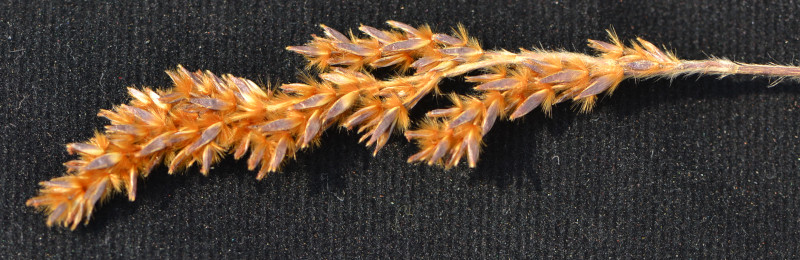
The grass is beautiful with soft velvety leaves and rufus inflorescences. It forms large tussocks with the roots submerged and the leaves almost always above water. Covered by this grass, the wetlands look slightly greyish. The small soft hair, being maybe an adaptation to the high UV intensity, is the cause of this effect.

The grass was introduced to me as Andropogon polypticus. The first thing to do was to confirm its identity. Since we were working with a competent botanist, D. Mohandass who was a research scholar at Pondicherry University and later worked for the Xishuangbanna Tropical Botanical Garden (XTBG), I relied on him to confirm the species’ name. Grasses are relatively difficult to identify as they require dissecting flowers that are one millimetre long, to describe the parts and understanding the structure of the inflorescence. To do so, it is best to have a good microscope, patience and stable hands.

I had asked Mohandass to provide me with the sketch of the flower parts that I could verify. Since he mostly worked with trees, he was not used to grasses and he kept on producing drawings that were not clear to me. After a few dedicated trials, I decided to ask the French Institute if I could use their microscope. The Director graciously accepted. I identified the grass as Eriochrysis rangacharii with the amazing book authored by Bor (1960). Since no one around us knew this species, I consulted the Red Data Book of Indian Plants by Nayar and Sastry (1987). There, we learnt that the species was “presumed extinct” because it had not been found for more than a century. With this surprising result, I checked again with Intkey (https://www.delta-intkey.com/grass/ident.htm), a digital key made especially for grasses, with the same result.

This caused problems. First, rediscovering a species is a surprise, and we could not take the risk of informing the public that we had “rediscovered” a species if it was good old A. polypticus. Second, if the species was so rare as to be missed by botanists for a century, then it might be in jeopardy, and serious effort might be necessary to preserve it. As I had interiorized that ecologists and particularly myself are poor botanists, I decided to ask a world-renowned grass specialist, Dr Cope of the British Museum, for verification. He generously looked at the grass and confirmed my identification. Following this, we wrote a small note to announce the rediscovery to botanists (Puyravaud et al. 2012).

Toda temple with preparations for ceremony

We decided then to do a small-scale study on this species to assess factors that threaten its existence (Puyravaud et al. 2012). Dr. Mohandass again carried out a field assessment and found that overgrazing by cattle reduced its density in the wetlands. Cows, contrary to the Toda buffaloes, have narrow hoofs that compact the soil. A relatively large number of cows would destroy the soil by crushing it, therefore reducing its ability to hold water. Consequently, the dry soil would affect the survival of E. rangacharii.

Cattle had been introduced by tea plantations and the workers of the Tamil Nadu Electricity Board. It was accepted, even encouraged that people would herd cattle. Unfortunately, the local ecology is not adapted to cattle grazing, and the survival of E. rangacharii was threatened even in the most remote and protected parts of the Nilgiri. During an assessment by the Rainforest Alliance, we encouraged the management of the Korakundah Tea Estate to protect some wetlands. Mr. D. Hegde, then in charge of the estate, was convinced of the importance of protecting wetlands and agreed to spare a few wetlands within the estate. Apart from this conservation effort, we did not go much further because we rapidly realized that there was very little interest in endangered plant species from donor agencies and we could not continue to fund studies ourselves.

We heard afterwards that a few anthropologists insisted that A. polypticus was the grass preferred by the Todas. We knew that the Todas recognize E. rangacharii without its flowers because the velvety leaves are soft whatever the direction they are stroked. A. polypticus’ leaves, on the contrary, are soft in one direction only. Confusion therefore is unlikely. But is it possible that the Todas use both species? Or a mixture of wetland grasses with E. rangacharii dominating? These questions should be examined further by specialists. However, it is remarkable that the people who remained fully aware of the status of the species were the Todas. Without their cultural traditions, no one would have known of the slow disappearance of E. rangacharii.

The story does not end here. I read later that Blasco (1971) had mentioned this species. His book was written in French, this is why it escaped the review of Nayar and Sastry (1987). The ‘rediscovery’ was after all an overstatement. Still, E. rangacharii definitely has a precarious status because the condition of natural wetland habitat is dire. The best would be to preserve the remote wetlands as they are and let this beauty of nature enjoy the howling wind of the monsoon play with its hair in the grey solitude of the mountain.

Jean-Philippe Puyravaud, 31 July 2026.

References

Blasco, F. (1971). Montagnes du sud de l’Inde: Forêts, savanes, écologie. Institut français de Pondichéry.

Bor, N. (1960). The grasses of Burma, Ceylon, India and Pakistan. Pergamon Press.

Puyravaud, J. P., Mohandass, D., & Chhabra, T. (2003). A rediscovery of Eriochrysis rangacharri Fischer (Poaceae) in the Nilgiri Mountains of southern India. Candollea, 58, 97–100.

Puyravaud, J. P., Mohandass, D., & Davidar, P. (2012). Impact of human-related disturbance on Eriochrysis rangacharii Fischer, a rare keystone endemic grass (Nilgiris, southern India): A preliminary assessment. Tropical Ecology, 53(1), 25–32.

Acknowledgement

Priya Davidar reviewed this article.

About this post

This post was written without the use of AI.