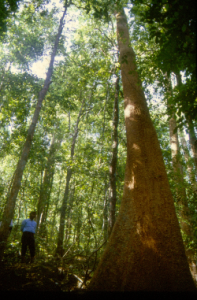
Incidents with elephants and deforestation

Located amidst imposing mountains in Karnataka with a perpetually misty landscape, Coorg is the place to be for all nature lovers. https://www.holidify.com/places/coorg/


Contrary to what is advertised, nature lovers might be a bit lost in Coorg.

We just published this paper “Deforestation Increases Frequency of Incidents With Elephants (Elephas maximus)” available here, in Tropical Conservation Science. It may be the first paper that shows a correlation between the intensity of deforestation and increased incidents with elephants.

The region this paper focused on was Coorg or Kodagu, in between the Nilgiris Biosphere Reserve and the Badra Tiger Reserve. In approximately 50 years, most private forests were transformed into coffee plantations. The Indian Forest Act did little to halt the degradation of forests. Today, the corridor between the Nilgiris Biosphere Reserve and the Badra Tiger Reserve is gone. Elephants remaining in this landscape are terrified, hungry and lost. They kill people and provoke destruction. To add to people’s difficulties, the price of coffee sometimes goes down, which is a reminder that monoculture may not be the best way to wealth. With global warming, the monsoon will probably become weaker, bringing less water and the “cleaning” of the forest may not bring the expected economic returns.

We avoided to use the word “conflict” to prefer the word “incidents”. Elephants are not in conflict with humans. They just attempt to survive in their former habitat that happens to be in between protected areas. The term “conflict” is convenient whenever we want to prove that elephants are responsible for a situation. But as we show in this paper, the only conflict is what we want to do with our world.

Jean-Philippe Puyravaud
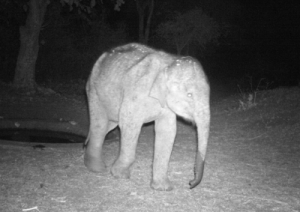
Global warming will destroy elephants

Following the 2017 drought, when many elephants died in Tamil Nadu and Karnataka, there was attempts to reassure the public regarding this particular situation (https://www.downtoearth.org.in/news/wildlife-and-biodiversity/elephants-in-drought-hit-karnataka-tamil-nadu-die-to-hunger-thirst-57661).

We posted a blog in this website to warn that if elephant populations were regulated by natural conditions centuries ago, today “unnatural” conditions imposed by humanity, prevail.

Indeed, we have just published an article based on thousands of observations in India and Nepal. With the lead author Dr. Rajapandian Kanagaraj an alumni of the Wildlife Institute of India, and currently at the National Museum of Natural Sciences at Madrid, Spain, this paper shows that global warming will destroy half of the elephant habitat in India. A first modelling technique detected the relationship between environment and elephant range. Then a second set of models proposed range changes under different climate change scenarios.

The results show that by the end of the century, 42% of the present elephant range will be lost because of global warming and land use changes. The temperature increase will affect the vegetation to provoke irreversible ecological damages and make ecosystems unusable by elephants. With impacts of this magnitude, we would also be wise to accelerate adaptation of farming practices because crop and animal production will certainly be badly affected as well.

The view of “business-as-usual” with wildlife – and our world – is an attitude of the past. We enter a period where all efforts possible to protect and mitigate global warming must be made.

Jean-Philippe Puyravaud

Trees comparative ecology

Plant conservation is driven by local protection and science. We have published a paper in the New Phytologist (soon to be available), on the organization of plant conduits (called xylem). Understanding the anatomy and physiology of plants has plenty of uses, including predicting reaction to global warming and species success in ecological restoration.

Astonishingly, the maximum xylem size (Dmax) of each organ showed similar scaling with plant size and consistent widening from leaf mid-vein via stem to main root across species, independently of growth form, relative growth rate and leaf habit. We also found strong coordination of Dmax with average leaf area and of stem xylem area with whole-plant leaf area. It appears that seedlings of ecologically wide-ranging woody species converge in their allometric scaling of conduit diameters within and across plant organs. These relationships will contribute to modeling of water transport in woody vegetation that accounts for the whole life history from the trees’ regeneration phase to adulthood.

In other words, something as simple as vessel size in plants (measured in standardized conditions), tells a lot about the tree species ecology and allows comparisons among species, that can be used in a variety of applications including conservation action and restoration.

Jean-Philippe Puyravaud