
How the Todas’ sacred grass was ‘rediscovered’
The Todas are a tiny tribal group living in the Nilgiri mountains in the Western Ghats of India. Traditionally, they relied on a special breed called Toda buffalo, who provided them with milk and butter. The preferred habitat of the buffalo is wetlands, originally abundant on the Nilgiri Plateau. The Todas derived their construction material from their immediate environment and the thatch for their temples is a wetland grass. Unfortunately, most of the native forests (locally called sholas) and grasslands, including the wetlands, have vanished under agriculture and plantations. Only the western side of the Nilgiri Plateau, under protection, still has wetlands which contains the Todas’ “sacred” grass.
Early 2000s, Tarun Chabbra, a retired dentist in Ooty, and a renowned specialist of the Toda culture, contacted me. The sacred grass was becoming rare, which created yet another stress for this tiny community. Tarun asked me to help understand why the grass was disappearing.
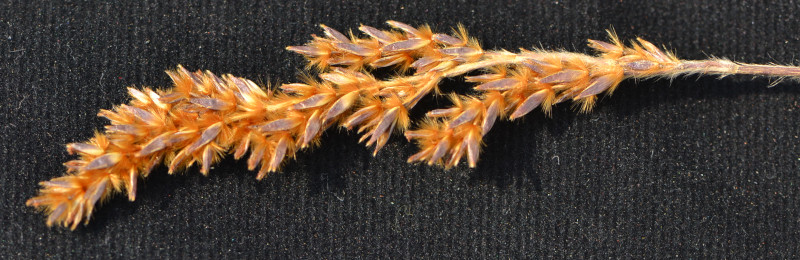
The grass is beautiful with soft velvety leaves and rufus inflorescences. It forms large tussocks with the roots submerged and the leaves almost always above water. Covered by this grass, the wetlands look slightly greyish. The small soft hair, being maybe an adaptation to the high UV intensity, is the cause of this effect.
The grass was introduced to me as Andropogon polypticus. The first thing to do was to confirm its identity. Since we were working with a competent botanist, D. Mohandass who was a research scholar at Pondicherry University and later worked for the Xishuangbanna Tropical Botanical Garden (XTBG), I relied on him to confirm the species’ name. Grasses are relatively difficult to identify as they require dissecting flowers that are one millimetre long, to describe the parts and understanding the structure of the inflorescence. To do so, it is best to have a good microscope, patience and stable hands.
I had asked Mohandass to provide me with the sketch of the flower parts that I could verify. Since he mostly worked with trees, he was not used to grasses and he kept on producing drawings that were not clear to me. After a few dedicated trials, I decided to ask the French Institute if I could use their microscope. The Director graciously accepted. I identified the grass as Eriochrysis rangacharii with the amazing book authored by Bor (1960). Since no one around us knew this species, I consulted the Red Data Book of Indian Plants by Nayar and Sastry (1987). There, we learnt that the species was “presumed extinct” because it had not been found for more than a century. With this surprising result, I checked again with Intkey (https://www.delta-intkey.com/grass/ident.htm), a digital key made especially for grasses, with the same result.
This caused problems. First, rediscovering a species is a surprise, and we could not take the risk of informing the public that we had “rediscovered” a species if it was good old A. polypticus. Second, if the species was so rare as to be missed by botanists for a century, then it might be in jeopardy, and serious effort might be necessary to preserve it. As I had interiorized that ecologists and particularly myself are poor botanists, I decided to ask a world-renowned grass specialist, Dr Cope of the British Museum, for verification. He generously looked at the grass and confirmed my identification. Following this, we wrote a small note to announce the rediscovery to botanists (Puyravaud et al. 2012).
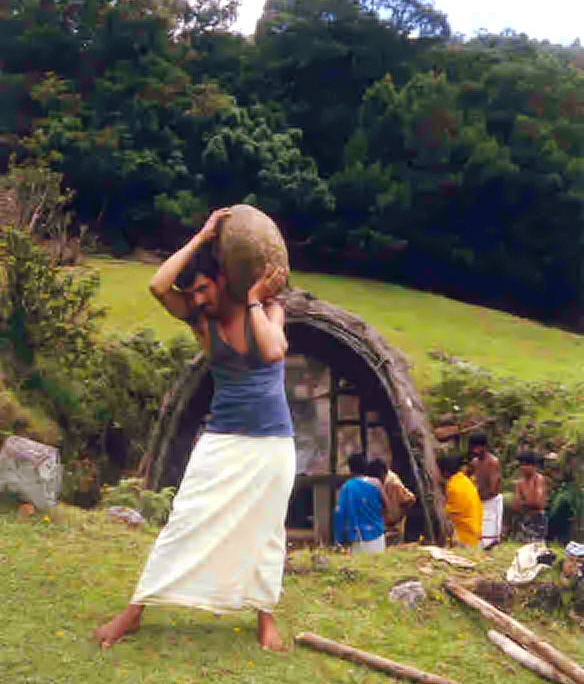
Toda temple with preparations for ceremony
We decided then to do a small-scale study on this species to assess factors that threaten its existence (Puyravaud et al. 2012). Dr. Mohandass again carried out a field assessment and found that overgrazing by cattle reduced its density in the wetlands. Cows, contrary to the Toda buffaloes, have narrow hoofs that compact the soil. A relatively large number of cows would destroy the soil by crushing it, therefore reducing its ability to hold water. Consequently, the dry soil would affect the survival of E. rangacharii.
Cattle had been introduced by tea plantations and the workers of the Tamil Nadu Electricity Board. It was accepted, even encouraged that people would herd cattle. Unfortunately, the local ecology is not adapted to cattle grazing, and the survival of E. rangacharii was threatened even in the most remote and protected parts of the Nilgiri. During an assessment by the Rainforest Alliance, we encouraged the management of the Korakundah Tea Estate to protect some wetlands. Mr. D. Hegde, then in charge of the estate, was convinced of the importance of protecting wetlands and agreed to spare a few wetlands within the estate. Apart from this conservation effort, we did not go much further because we rapidly realized that there was very little interest in endangered plant species from donor agencies and we could not continue to fund studies ourselves.
We heard afterwards that a few anthropologists insisted that A. polypticus was the grass preferred by the Todas. We knew that the Todas recognize E. rangacharii without its flowers because the velvety leaves are soft whatever the direction they are stroked. A. polypticus’ leaves, on the contrary, are soft in one direction only. Confusion therefore is unlikely. But is it possible that the Todas use both species? Or a mixture of wetland grasses with E. rangacharii dominating? These questions should be examined further by specialists. However, it is remarkable that the people who remained fully aware of the status of the species were the Todas. Without their cultural traditions, no one would have known of the slow disappearance of E. rangacharii.
The story does not end here. I read later that Blasco (1971) had mentioned this species. His book was written in French, this is why it escaped the review of Nayar and Sastry (1987). The ‘rediscovery’ was after all an overstatement. Still, E. rangacharii definitely has a precarious status because the condition of natural wetland habitat is dire. The best would be to preserve the remote wetlands as they are and let this beauty of nature enjoy the howling wind of the monsoon play with its hair in the grey solitude of the mountain.
Jean-Philippe Puyravaud, 31 July 2026.
References
Blasco, F. (1971). Montagnes du sud de l’Inde: Forêts, savanes, écologie. Institut français de Pondichéry.
Bor, N. (1960). The grasses of Burma, Ceylon, India and Pakistan. Pergamon Press.
Puyravaud, J. P., Mohandass, D., & Chhabra, T. (2003). A rediscovery of Eriochrysis rangacharri Fischer (Poaceae) in the Nilgiri Mountains of southern India. Candollea, 58, 97–100.
Puyravaud, J. P., Mohandass, D., & Davidar, P. (2012). Impact of human-related disturbance on Eriochrysis rangacharii Fischer, a rare keystone endemic grass (Nilgiris, southern India): A preliminary assessment. Tropical Ecology, 53(1), 25–32.
Acknowledgement
Priya Davidar reviewed this article.
About this post
This post was written without the use of AI.